Image-Based Deep Learning Tool Img2Variety Released for Crop Variety Identification
Accurate identification of crop varieties is a fundamental requirement for precision breeding and germplasm resource management. However, phenotypic differences among varieties within the same crop are often subtle, and early-stage morphological traits are highly unstable. Achieving reliable variety discrimination at early growth stages is therefore critical for shortening breeding cycles and improving experimental efficiency. Traditional approaches based on expert experience or molecular markers remain costly and inefficient for large-scale applications. Meanwhile, existing image-based studies that rely on local morphological features, such as leaf images, are typically restricted to specific crops or growth stages, limiting their applicability to real-world breeding scenarios that require multi-crop and cross-growth-stage identification.
Recently, the China National Center for Bioinformation (CNCB) released Img2Variety, a deep learning–based image recognition framework for crop variety identification. The study, entitled “Img2Variety: Image-based intraspecific varieties identification across the whole growth period,” was published online in the international journal Plant Phenomics. This work systematically evaluates the performance of image-based variety identification across multiple crops and growth stages, providing a new technical solution for crop variety discrimination using plant images.
Img2Variety takes RGB images of whole plants as input and adopts a transfer learning strategy, in which multiple classical convolutional neural network architectures are fully fine-tuned to address the challenge of numerous varieties with limited samples per variety. To cope with large phenotypic variations caused by different growth stages and imaging viewpoints, the study introduces a mixed augmentation strategy that combines growth-stage and multi-view information while preserving variety labels, thereby expanding the training data distribution. In addition, an adaptive cross-entropy loss function is employed to enhance the model’s attention to easily confused samples and improve inter-variety discrimination. The framework was validated on two crop datasets: a rice dataset comprising 11,170 images of 93 varieties spanning the entire growth period, and a maize dataset containing 5,599 images of 224 inbred lines across nine growth stages. Experimental results showed that Img2Variety achieved peak identification accuracies of 88.66% on rice and 79.95% on maize, and exceeded 80% accuracy at certain early growth stages, including the pre-heading stage in rice and the tenth-leaf stage in maize. Furthermore, consistent performance gains were observed across six baseline network architectures, with average accuracy improvements of 15.09 percentage points on the rice dataset and 34.65 percentage points on the maize dataset. These results demonstrate that Img2Variety exhibits robust generalization across both network structures and crop types. Overall, the study highlights the potential of deep learning approaches that integrate transfer learning, multi-stage image information, and targeted training strategies for fine-grained crop variety identification. The Img2Variety framework and related tools are publicly available through a web platform (https://ngdc.cncb.ac.cn/opia/img2variety), providing support for method comparison, algorithm development, and further research.
CAO Yongrong, a PhD student at the China National Center for Bioinformation, is the first author of the study. Senior Engineer TIAN Dongmei and Professor SONG Shuhui served as co-corresponding authors. This work was supported by the Strategic Priority Research Program of the Chinese Academy of Sciences, the National Key Research and Development Program, and the Biological Breeding-National Science and Technology Major Project.
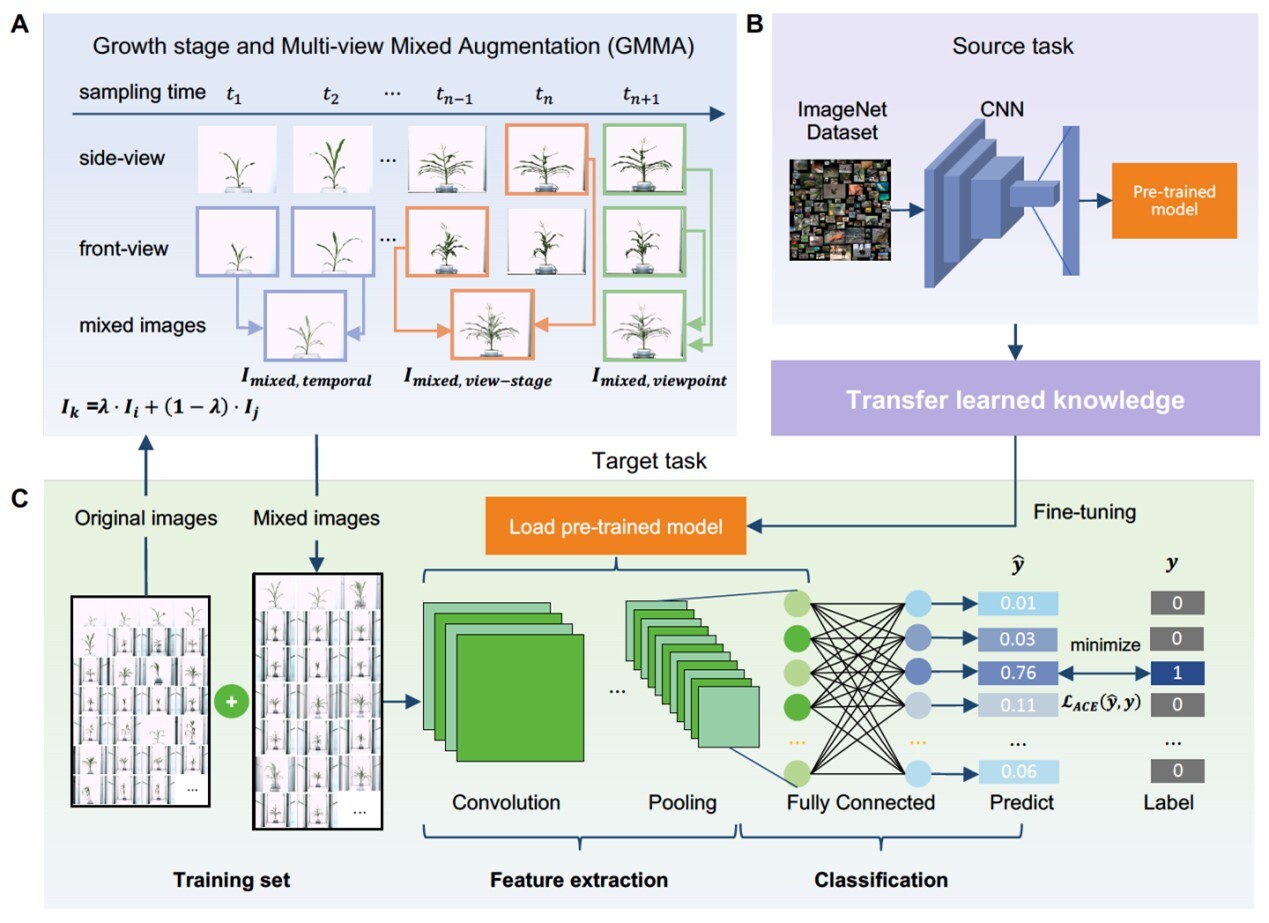
Design of Img2Variety framework