Asymmetric Translation Governs Embryonic Cell Fate: Researchers Identify a Key Factor RBBP7 for Early Mammalian Development
The first cell fate decision of the fertilized mammalian zygote represents a key scientific question in developmental biology and is closely relevant to embryo quality evaluation in assisted reproduction. Previous studies have revealed that the non coding RNA LincGET mediates cell fate bias at the two cell stage; nevertheless, the key protein factor governing this process remained elusive.
Recently, a collaborative research teams led by scientists from the China National Center for Bioinformation, together with the China Agricultural University and Wuhan University, identified RBBP7, the earliest functionally asymmetric protein at the mouse two cell stage, and uncovered a novel mechanism whereby asymmetric translation drives differential histone modifications to shape early embryonic lineage bias.
The study was published in Cell Discovery on August 18.
In mouse two cell stage embryos, RBBP7 acts as a core subunit of the NuRD (Nucleosome Remodeling and Deacetylase) complex. It physically interacts with histone deacetylase HDAC1 to mediate deacetylation of H3K9ac. Higher RBBP7 protein abundance in one blastomere corresponds with lower H3K9ac modification levels, and vice versa. Knockdown of Rbbp7 diminishes inter blastomere asymmetry of H3K9ac, while upregulating the inner cell mass (ICM) marker gene Sox2 and driving blastomeres toward the ICM fate. These findings illustrate the RBBP7 HDAC1 H3K9ac regulatory axis as a key orchestrator of initial cell fate specification in early mammalian embryos.
The non coding RNA LincGET is known to trigger early fate bias and promote ICM commitment at the mouse two cell stage. This study shows that RBBP7 and LincGET exhibit concordant asymmetric distribution within the same blastomere, yet exert fully antagonistic functions: LincGET promotes ICM fate, whereas RBBP7 restricts ICM specification. Neither factor regulates the expression of the other. Double knockdown or co overexpression can partially rescue the cell fate bias. These results uncover an RNA protein synergistic counterbalancing network that provides the molecular basis for preserving developmental plasticity in two cell stage embryos.
Technical challenges persist in dissecting translational heterogeneity from scarce embryonic samples. The research team optimized and developed scpRibo seq, a single cell translatome sequencing technique, coupled with in situ nascent protein tracing assays. Single cell omics data demonstrate that at the late two cell stage, Rbbp7 mRNA abundance is comparable between sister blastomeres, while its translational efficiency differs markedly. Such translational imbalance gives rise to asymmetric RBBP7 protein abundance, establishing translational control as the primary source of protein heterogeneity in early mammalian embryos.
Collectively, this work identifies the earliest asymmetric protein factor in mammals, extending the framework for embryonic symmetry breaking beyond transcriptional regulation to translational epigenetic control. The scpRibo seq technology overcomes technical bottlenecks in translatomic profiling of minute quantity embryonic samples. Moreover, RBBP7 and H3K9ac show promise as biomarkers for embryonic developmental potential, providing new tools and a theoretical foundation for embryo assessment in assisted reproduction and for mechanistic investigation of developmental defects.
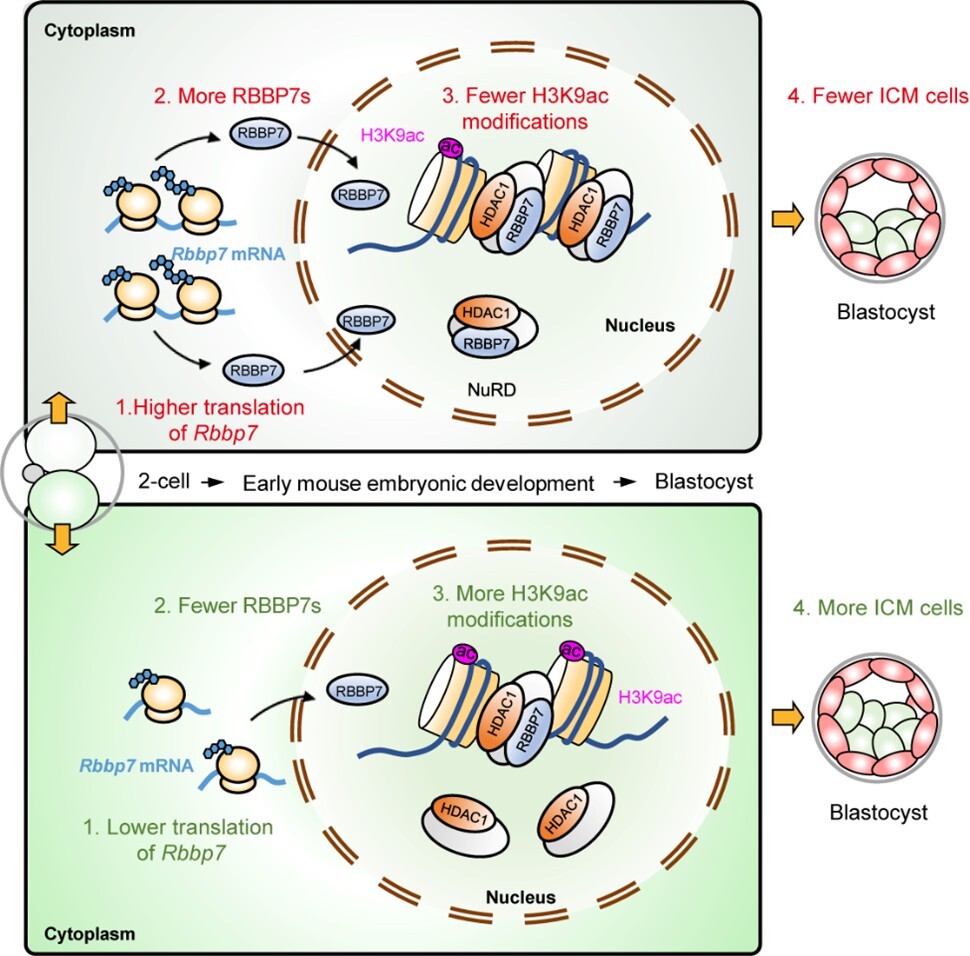
Figure: Asymmetric translation of RBBP7 governs cell fate determination of mammalian two cell embryos.