Scientists Identify Gut Bacterium BP and Its Metabolite 5-AVAB That Can Delay Aging
A new study published in Nature Aging on August 25 reports that a single gut bacterium—Bifidobacterium pseudocatenulatum (BP)—together with a small molecule it produces, 5-aminovaleric acid betaine (5-AVAB), can alleviate multiple hallmarks of aging and extend healthy lifespan in mice, opening a promising new avenue toward healthier aging in humans.
The study was led by Prof. Weiqi Zhang and Prof. Yun-Gui Yang at the China National Center for Bioinformation, a research center affiliated with the Chinese Academy of Sciences (CAS), in collaboration with Prof. Guang-Hui Liu and Prof. Jing Qu at the Institute of Zoology of the Chinese Academy of Sciences, and Prof. Feng Zhang at the Quzhou Affiliated Hospital of Wenzhou Medical University.
By analyzing Chinese aging cohorts, the team found that adults generally fall into two major gut microbiome patterns: one dominated by Bacteroides and the other by Prevotella. Among individuals with the Prevotella-dominant pattern, beneficial gut bacteria were lost more rapidly with age, while microbes carrying virulence factors and antibiotic-resistance genes steadily increased.
One bacterium stood out across all cohorts: BP. Its abundance declined sharply with age in both men and women, regardless of gut pattern. Using a newly developed "microbiome aging clock" called MicroAge, the researchers found that individuals carrying higher levels of BP tended to exhibit a younger biological age, a trend consistently validated across multiple routine clinical health indicators.
The team then investigated the molecular basis of BP's beneficial effects. They traced its geroprotective activity to a single functional metabolite—5-AVAB, whose circulating levels also decline with age in humans. When aged mice were given 5-AVAB directly, their memory, motor coordination and mood-related behaviors all improved, and chronic low-grade inflammation in the liver, lungs, muscles, kidneys, heart and spleen was significantly attenuated, effects consistent with those observed when the live BP bacterium itself was administered.
Together, these findings point to a simple yet powerful strategy for promoting healthy aging: replenish the missing microbe, or supplement its key metabolite.
This study was supported by the Aging Biomarker Consortium (ABC).
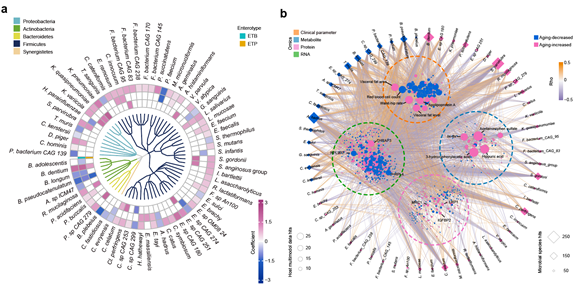
Fig. Aging is accompanied by widespread shifts in gut microbial abundance, and age-associated differential species are strongly correlated with host molecular signatures and phenotypes.