iCellOmics: connecting multi-omics profiles and phenotype evidence across industrially relevant cell lines
Industrially relevant cell lines include both direct production hosts (e.g., CHO, HEK293, and Vero cells) for recombinant proteins, vaccines, and viral vectors, and biomedical models (e.g., HeLa, Jurkat, and K562) that serve as references for host-cell engineering and comparative studies. These cell lines support the development and worldwide supply of recombinant therapeutics, viral vaccines, and gene therapies. However, their genomic, transcriptomic, and epigenomic profiles, together with literature-derived phenotype knowledge, remain scattered across different repositories, projects, and publications, often relying on varying reference genomes and analytical workflows, which hinders a systematic understanding of these cell lines.
Recently, China National Center for Bioinformation (CNCB-NGDC), National Genomics Data Center has released iCellOmics (https://ngdc.cncb.ac.cn/icellomics), an open-access multi-omics database for industrial cell lines. The work “iCellOmics: connecting multi-omics profiles and phenotype evidence across industrially relevant cell lines” was published online in Nucleic Acids Research on November 10. This work integrates, for the first time, multi-omics data and literature-curated gene–phenotype knowledge for multiple industrially relevant cell lines within a unified data analysis framework, filling the gap in multi-cell-line multi-omics data integration resources for industrial cell lines.
The current release of iCellOmics covers 17 industrially relevant cell lines and integrates six data categories: reference genomes and annotation information for seven species, encompassing 144,018 protein-coding genes; 170,408,888 genomic variants with functional annotations from 55 whole-genome sequencing projects across 15 cell lines; 673 differential-expression comparisons from 241 bulk transcriptome sequencing projects; 1,047,274 cells from 30 single-cell transcriptome sequencing projects; 287,089,415 chromatin-accessibility peaks from 171 ATAC-seq projects; and 37,213 gene–phenotype relationships extracted from 6,312 publications, involving 6,605 gene/protein entities and spanning 104 standardized phenotype subcategories.
iCellOmics supports both “cell line-centric” data browsing and “gene-centric” cross-omics retrieval: users can quickly browse the amount of available data across modules by cell line, or obtain, through Gene Search, an integrated profile of a specific gene in a given cell line, covering variant sites, expression comparisons, accessible chromatin regions, an overview of single-cell transcriptome data, and gene–phenotype relationships extracted from the literature. In addition, iCellOmics organizes the literature-curated gene–phenotype relationships into an interactive knowledge graph, with switchable detailed and collapsed views, filterable by cell line, phenotype category, entity name, relationship type, and PubMed ID, and displays the associated literature context, experimental perturbations, and reported effects for each relationship, providing knowledge-guided support for host-cell engineering. Additionally, iCellOmics integrates the JBrowse 2 genome browser and online GO/KEGG enrichment analysis tools, and offers downloadable processed data for reference genomes, chromatin accessibility, and single-cell transcriptomes, facilitating local analyses.
In brief, the rich multi-omics data and gene–phenotype knowledge in iCellOmics not only provide valuable data support for basic research, but also promote the engineering of industrial cell lines and the development and optimization of high-yield, stable producer cell lines.
Gao Xiaojing, Chen Yongbo, Xu Mengtong, Zhou Yiran, and Li Tuocen, graduate students at the National Center for Bioinformation, are co-first authors of the paper. Zhao Wenming, a senior engineer, and Tang Bixia, a senior engineer, are co-corresponding authors. This work was supported by the Strategic Priority Research Program of the Chinese Academy of Sciences.
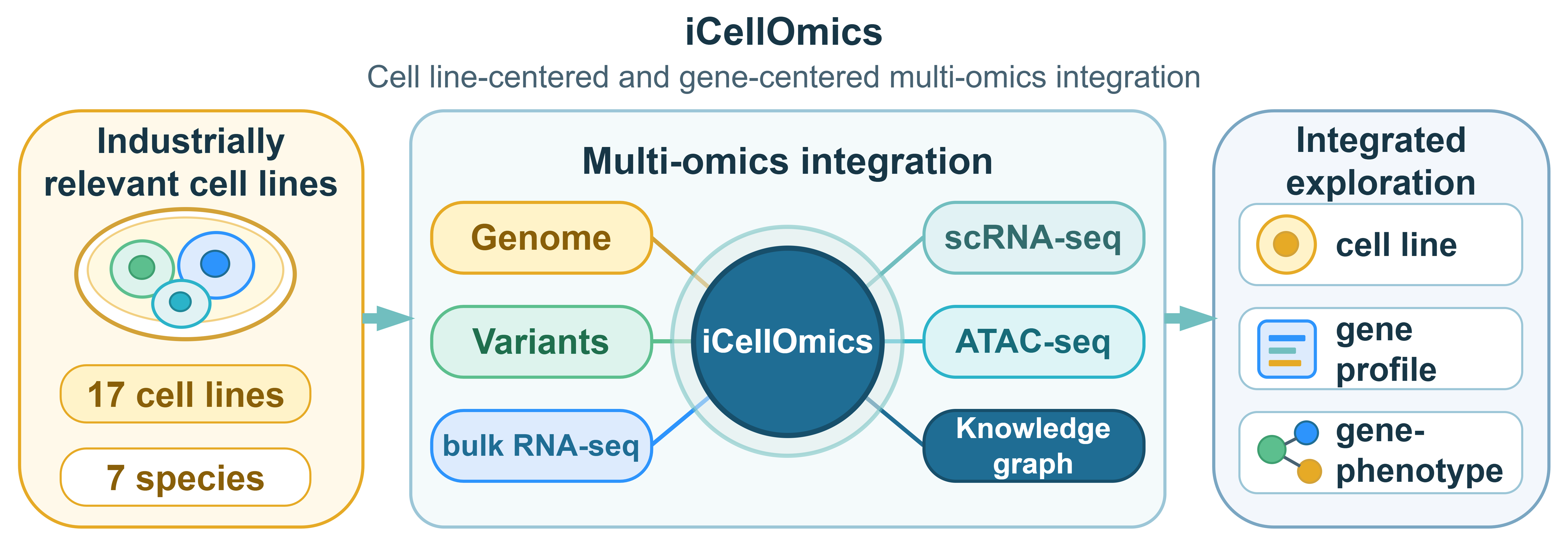
Fig. iCellOmics: Cell line-centered and gene-centered multi-omics integration
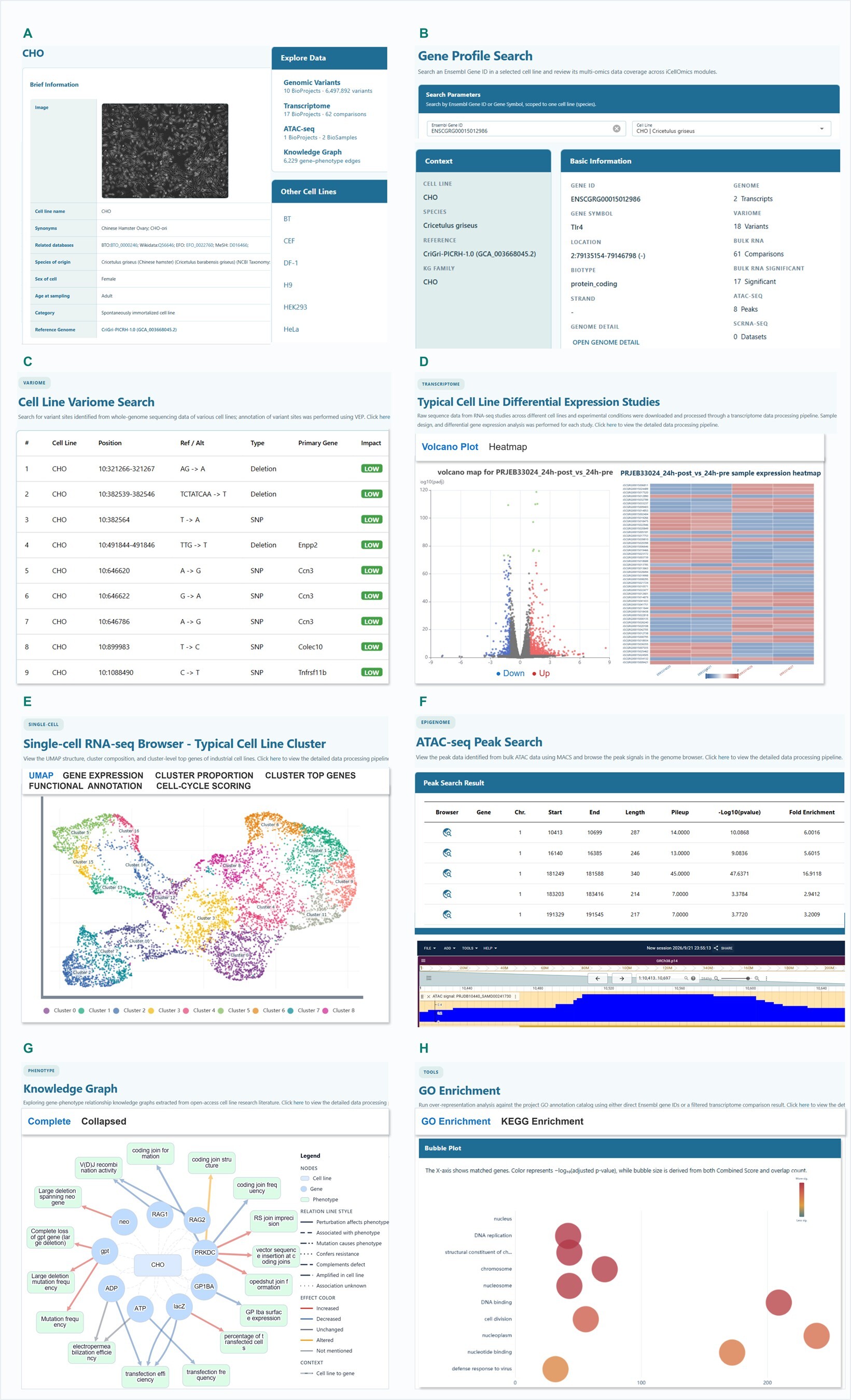
Fig. Snapshots of browsing, searching and display in iCellOmics